
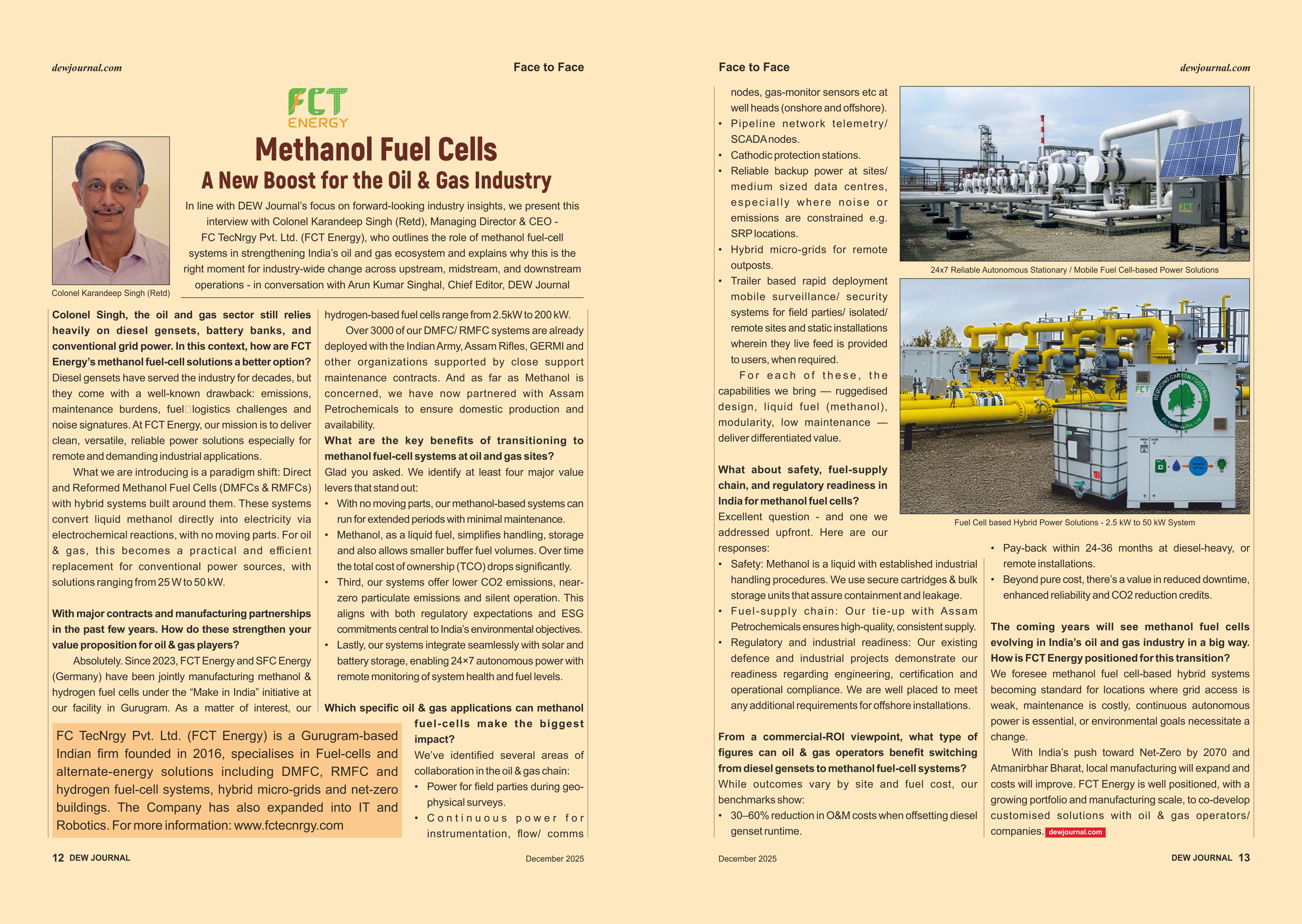
In line with DEWJournal's focus on forward-looking industry insights, we present this interviewwith Colonel Karandeep Singh (Retd), Managing Director & CEO - FC TecNrgyPvt. Ltd. (FCT Energy), who outlines the role of methanol fuel-cell systems in strengtheningIndia's oil and gas ecosystem and explains why this is the right moment forindustry-wide change across upstream, midstream, and downstream operations - inconversation with Arun Kumar Singhal, Chief Editor, DEW Journal
FC TecNrgy Pvt. Ltd. (FCT Energy) is a Gurugram-based Indianfirm founded in 2016, specialises in Fuel-cells and alternate-energy solutionsincluding DMFC, RMFC and hydrogen fuel-cell systems, hybrid micro-grids andnet-zero buildings. The Company has also expanded into IT and Robotics. Formore information: www.fctecnrgy.com
1. Colonel Karandeep Singh (Retd) Colonel Singh, the oil andgas sector still relies heavily on diesel gensets, battery banks, andconventional grid power. In this context, how are FCT Energy's methanolfuel-cell solutions a better option?
Diesel gensets have served the industry for decades, butthey come with a well-known drawback: emissions, maintenance burdens, fuellogistics challenges and noise signatures. At FCT Energy, our mission is todeliver clean, versatile, reliable power solutions especially for remote anddemanding industrial applications.
What we are introducing is a paradigm shift: Direct andReformed Methanol Fuel Cells (DMFCs & RMFCs) with hybrid systems builtaround them. These systems convert liquid methanol directly into electricityvia electrochemical reactions, with no moving parts. For oil & gas, thisbecomes a practical and efficient replacement for conventional power sources,with solutions ranging from 25 W to 50 kW.
2. With major contracts and manufacturing partnerships inthe past few years. How do these strengthen your value proposition for oil& gas players?
Absolutely. Since 2023, FCT Energy and SFC Energy (Germany)have been jointly manufacturing methanol & hydrogen fuel cells under the"Make in India" initiative at our facility in Gurugram. As a matterof interest, our hydrogen-based fuel cells range from 2.5kW to 200 kW.
Over 3000 of our DMFC/ RMFC systems are already deployedwith the Indian Army, Assam Rifles, GERMI and other organizations supported byclose support maintenance contracts. And as far as Methanol is concerned, wehave now partnered with Assam Petrochemicals to ensure domestic production andavailability.
3. What are the key benefits of transitioning to methanolfuel-cell systems at oil and gas sites?
Glad you asked. We identify at least four major value leversthat stand out:
With no moving parts, our methanol-based systems can run forextended periods with minimal maintenance.
• Methanol, as a liquid fuel, simplifies handling, storageand also allows smaller buffer fuel volumes. Over time the total cost ofownership (TCO) drops significantly. Third, our systems offer lower CO2emissions, near- zero particulate emissions and silent operation. This alignswith both regulatory expectations and ESG commitments central to India'senvironmental objectives. Lastly, our systems integrate seamlessly with solarand battery storage, enabling 24×7 autonomous power with remote monitoring of systemhealth and fuel levels.
4. Which specific oil & gas applications can methanolfuel-cells make the biggest impact?
We've identified several areas of collaboration in the oil& gas chain:
Power for field parties during geo- physical surveys.
• Continuous power for instrumentation, flow/ comms nodes,gas-monitor sensors etc at well heads (onshore and offshore).
• Pipeline network telemetry/ SCADA nodes.
• Cathodic protection stations. Reliable backup power atsites/ medium sized data centres, especially where noise or emissions areconstrained e.g. SRP locations.
• Hybrid micro-grids for remote outposts.
• Trailer based rapid deployment mobile surveillance/security systems for field parties/ isolated/ remote sites and staticinstallations wherein they live feed is provided to users, when required.
For each of these, the capabilities we bring ruggedised design,liquid fuel (methanol), modularity, low maintenance deliver differentiatedvalue.
5. What about safety, fuel-supply chain, and regulatoryreadiness in India for methanol fuel cells?
Excellent question and one we addressed upfront. Here areour responses:
24x7 Reliable Autonomous Stationary / Mobile Fuel Cell-basedPower Solutions
Fuel Cell based Hybrid Power Solutions - 2.5 kW to 50 kWSystem
• Safety: Methanol is a liquid with established industrialhandling procedures. We use secure cartridges & bulk storage units thatassure containment and leakage.
• Fuel-supply chain: Our tie-up with Assam Petrochemicalsensures high-quality, consistent supply.
• Regulatory and industrial readiness: Our existing defenceand industrial projects demonstrate our readiness regarding engineering,certification and operational compliance. We are well placed to meet anyadditional requirements for offshore installations.
6. From a commercial-ROI viewpoint, what type of figures canoil & gas operators benefit switching from diesel gensets to methanolfuel-cell systems?
While outcomes vary by site and fuel cost, our benchmarksshow:
Pay-back within 24-36 months at diesel-heavy, or remoteinstallations.
Beyond pure cost, there's a value in reduced downtime,enhanced reliability and CO2 reduction credits.
7. The coming years will see methanol fuel cells evolving inIndia's oil and gas industry in a big way. How is FCT Energy positioned forthis transition?
We foresee methanol fuel cell-based hybrid systems becomingstandard for locations where grid access is weak, maintenance is costly,continuous autonomous power is essential, or environmental goals necessitate achange.
With India's push toward Net-Zero by 2070 and AtmanirbharBharat, local manufacturing will expand and costs will improve. FCT Energy iswell positioned, with a growing portfolio and manufacturing scale, toco-develop
• 30-60% reduction in O&M costs when offsetting dieselcustomised solutions with oil & gas operators/ genset runtime.